

Accessory components
Stable Baselines Start With the Right Accessories
To ensure reliable results even in challenging applications, we offer — alongside our individual modules — a wide range of accessory components. Here you will find everything related to temperature control, degassing, mobile phase delivery, and flow-path switching: vacuum degassers, inert-gas reagent manifolds, compact on-system solvent racks, precision HPLC valves, and column thermostats engineered to stabilise baselines, protect sensitive chemistry, and make the most of limited bench space.
Degassing
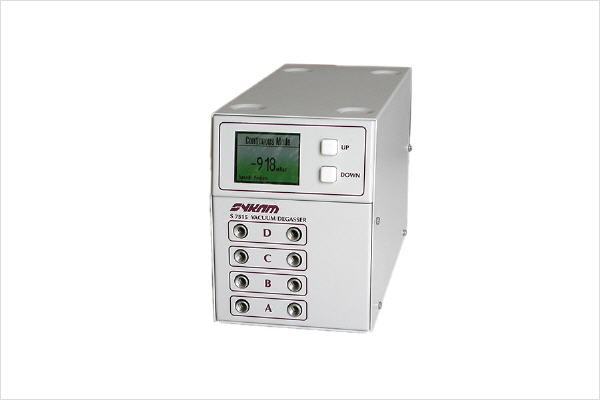
S 7515 — Vacuum Degasser
Continuous-flow membrane degassing for quiet pumps and stable detectors
Dissolved air and other gases in mobile phase are a common source of baseline noise, flow instability, and detector artefacts — especially at low flow rates or with aqueous buffers. The S 7515 is a continuously flushed, high-efficiency degasser: solvents pass a semi-permeable membrane while vacuum is applied on the opposite side, stripping dissolved gases without contaminating the flow path. Configure up to four independent channels so multi-solvent gradients stay gas-free from bottle to pump.
Specifications
- Wetted materials
- Teflon AF®, PTFE (Teflon), stainless steel, aluminium, EPDM
- Internal volume (per channel)
- < 500 µl
- Channels
- Up to 4
- Degassing performance
- < 20% residual dissolved gases in water at 1.0 ml/min (typical)
Why it matters
Lower dissolved-gas load means more stable check valves, fewer air spikes in the flow cell, and cleaner baselines for UV, RI, and MS interfaces — so your methods tolerate real-world solvent handling without constant troubleshooting.
Solvent supply
Stainless steel reagent manifold
Pressure-rated solvent reservoir rack for inert-gas lab feeds
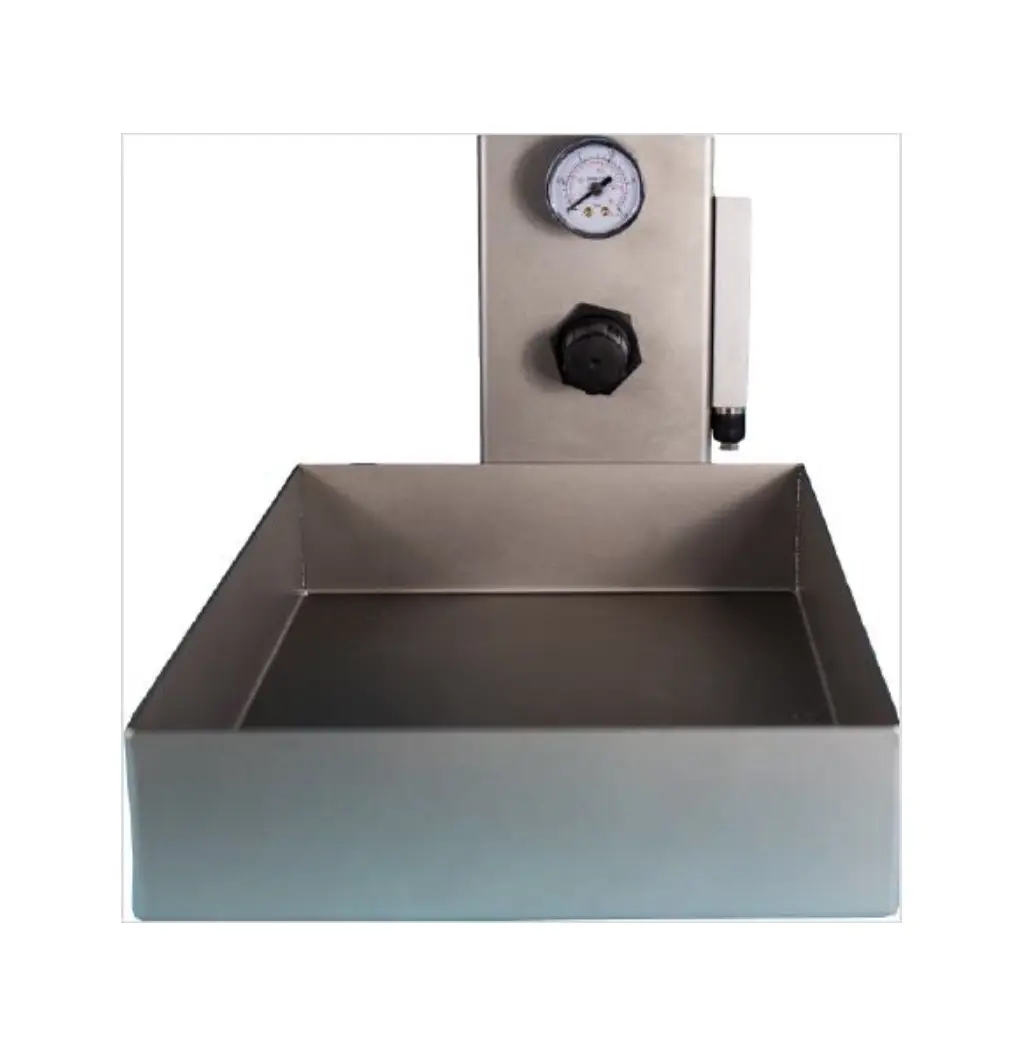
Our stainless reagent manifold is designed as a solvent reservoir rack for Sykam instrument families where chemistry and cleanliness matter. The all-stainless construction is chosen for aseptic, solvent-resistant service and long-term compatibility with aggressive eluents. The pressure-stable design accepts inlet pressures up to 15 bar and can be adapted to standard inert-gas laboratory distribution. Use it to sparge and blanket solvents with helium for degassing, or to store buffers under inert gas for oxygen-sensitive work — so your mobile phase stays consistent from fill to finish.
Specifications
- Construction
- Stainless steel (aseptic, solvent-resistant)
- Max inlet pressure
- Up to 15 bar
- Gas connection
- Adaptable to common inert-gas lab supplies
- Typical uses
- Helium-assisted degassing / sparging; oxygen-free storage of buffers under inert gas
Ideal for
Labs that standardise on helium-sparged solvents, run oxygen-sensitive methods, or need a robust, cleanable manifold that sits naturally alongside Sykam stack systems.
Solvent organisation
System solvent rack
Secure, space-saving bottle placement mounted directly on the instrument
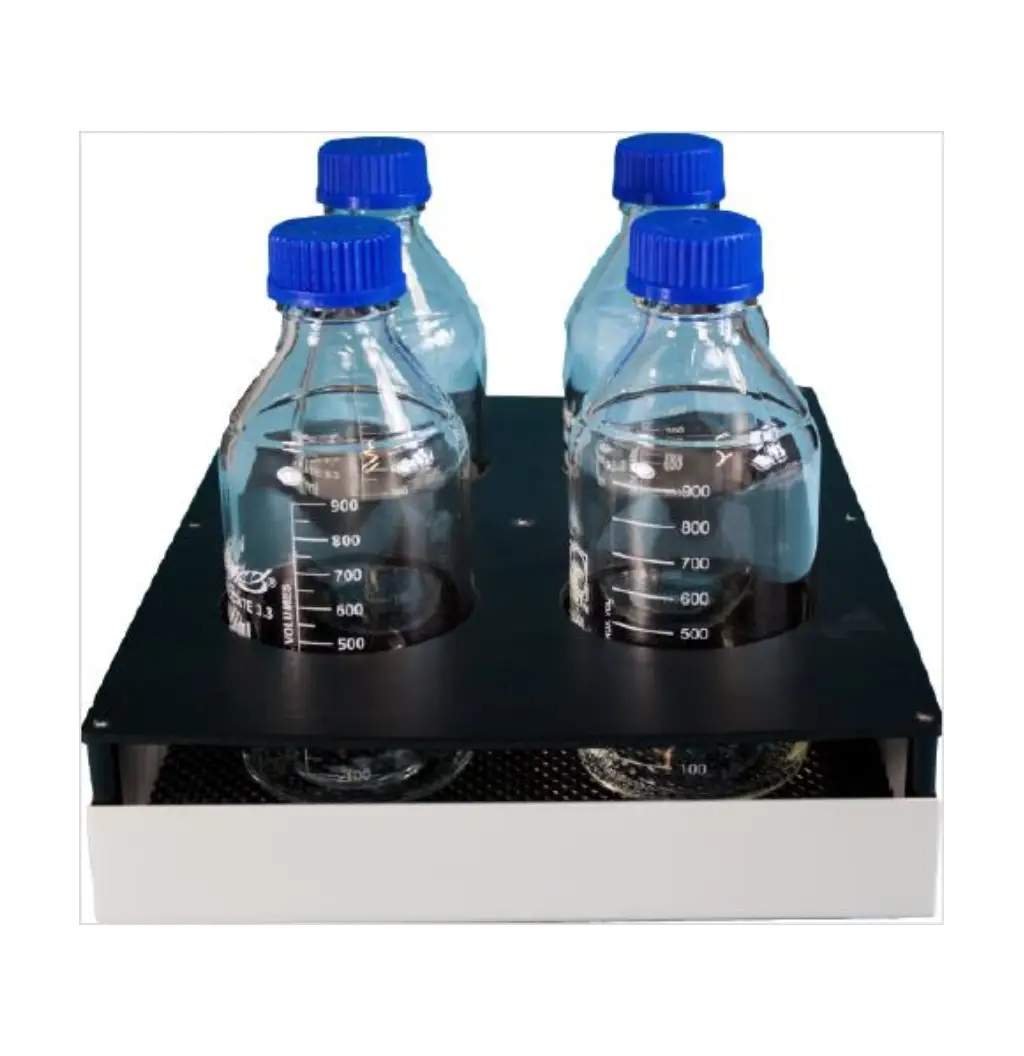
The system rack combines a sturdy holder with a drip tray and is available in two footprints. Bottles sit safely above the module, freeing bench space and reducing the risk of spills reaching electronics or cable routes. Mounting directly on the system makes the most of tight lab layouts while keeping solvent lines short and tidy — a small detail that pays off in everyday handling and method consistency.
Specifications
- Small configuration (L × W × H)
- 310 × 425 × 80 mm
- Large configuration (L × W × H)
- 430 × 400 × 80 mm
Best suited to
Laboratories that want solvents and waste contained in one footprint with the instrument — especially where floor or bench space is limited.
Temperature control
S 4115 — Column oven
Direct-contact heating for repeatable retention and robust methods
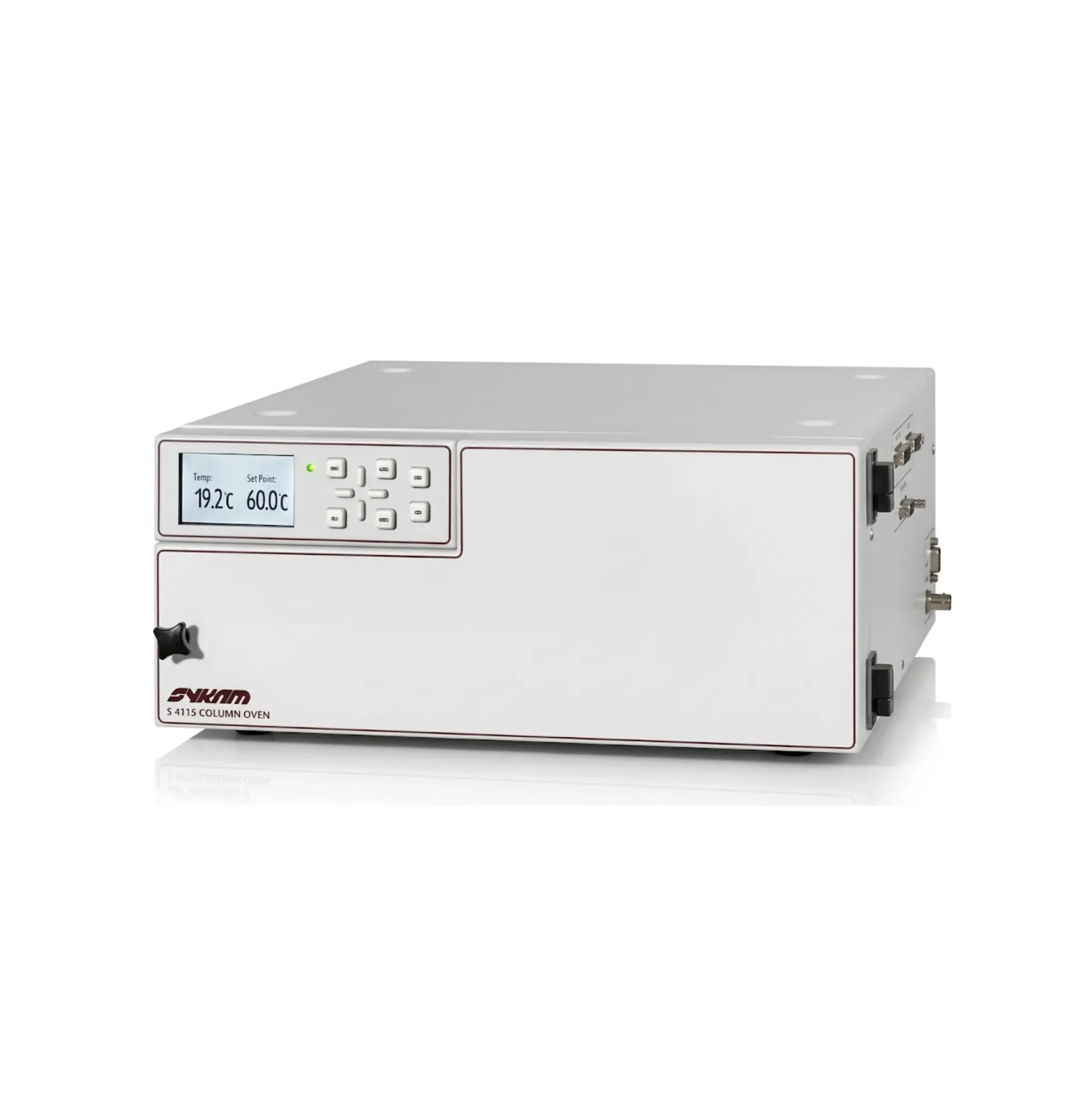
Chromatography thrives on stable boundary conditions: when column temperature drifts, retention times and resolution drift with it. The S 4115 column thermostat delivers direct-contact heating with tight temperature stability so your method stays locked in — from pharmaceutical release testing to routine QC. Optional Peltier cooling extends the working range for applications that need sub-ambient starts; integrated valve options are available where your workflow benefits from column switching on the same platform.
Specifications
- Temperature stability
- ±0.1°C
- Heating range
- 30°C – 100°C
- Columns
- Up to 2
- Cooling (optional)
- Peltier option down to 5°C
- Integration
- Optional integrated valve; OEM configurations available
Applications
Methods where retention must track tightly across batches and ambient seasons — including pharma, food, environmental, and regulated QC environments.
Temperature control
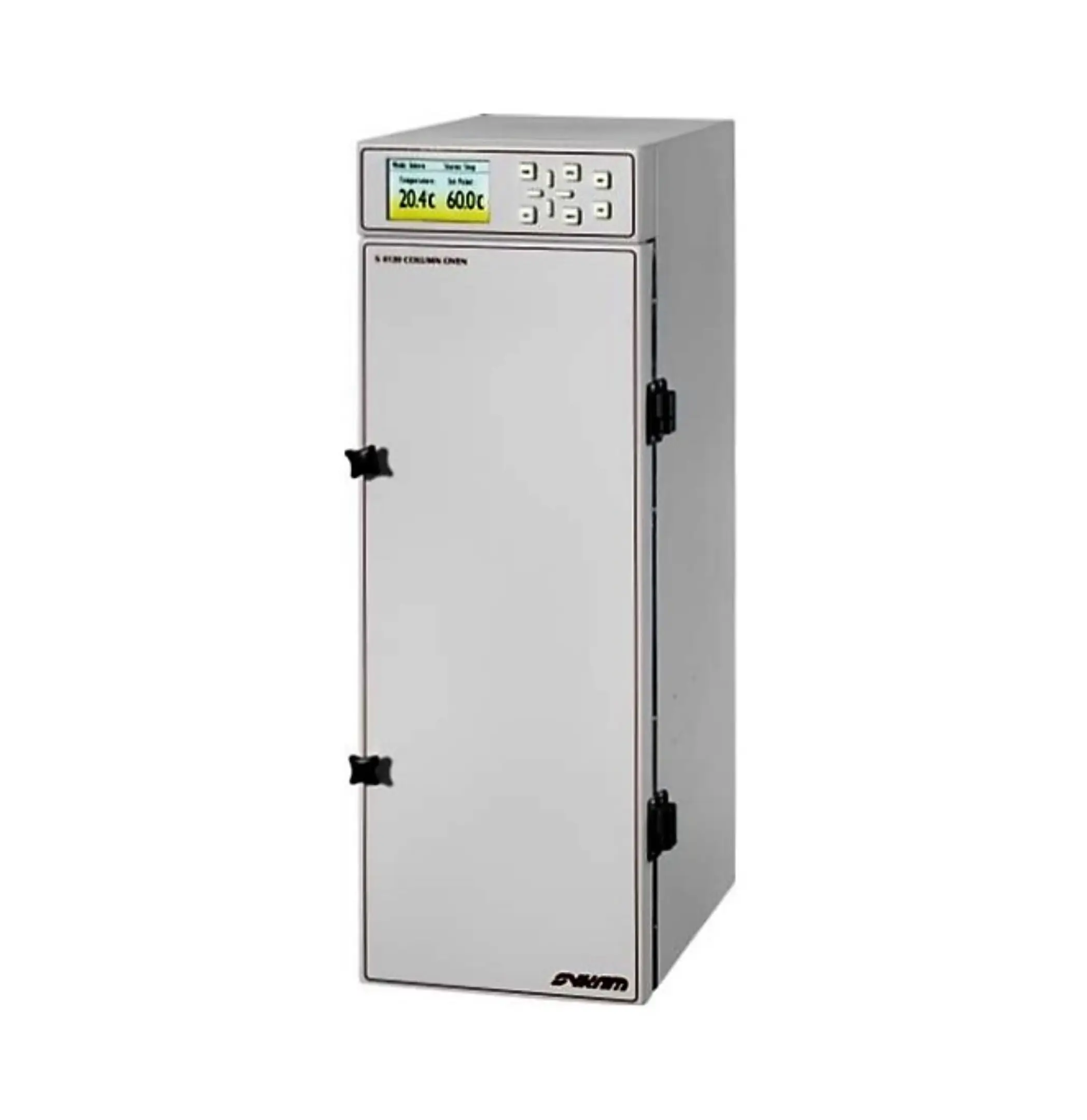
S 4120 — Column oven
Higher temperature ceiling and three-column capacity for demanding separations
When your separation needs more thermal headroom or additional column positions, the S 4120 builds on the same direct-contact philosophy as the S 4115 with an extended heating range and accommodation for up to three columns. That makes method development and column screening faster — without sacrificing the thermal precision that keeps retention factors where you set them. Optional Peltier cooling and integrated valve options mirror the flexibility labs expect from Sykam thermostats.
Specifications
- Temperature stability
- ±0.1°C
- Heating range
- 30°C – 150°C
- Columns
- Up to 3
- Cooling (optional)
- Peltier option down to 5°C
- Integration
- Optional integrated valve; OEM configurations available
Applications
Higher-temperature LC methods, multi-column setups, and workflows where extra capacity and thermal span reduce compromise during method transfer.
Fluid path
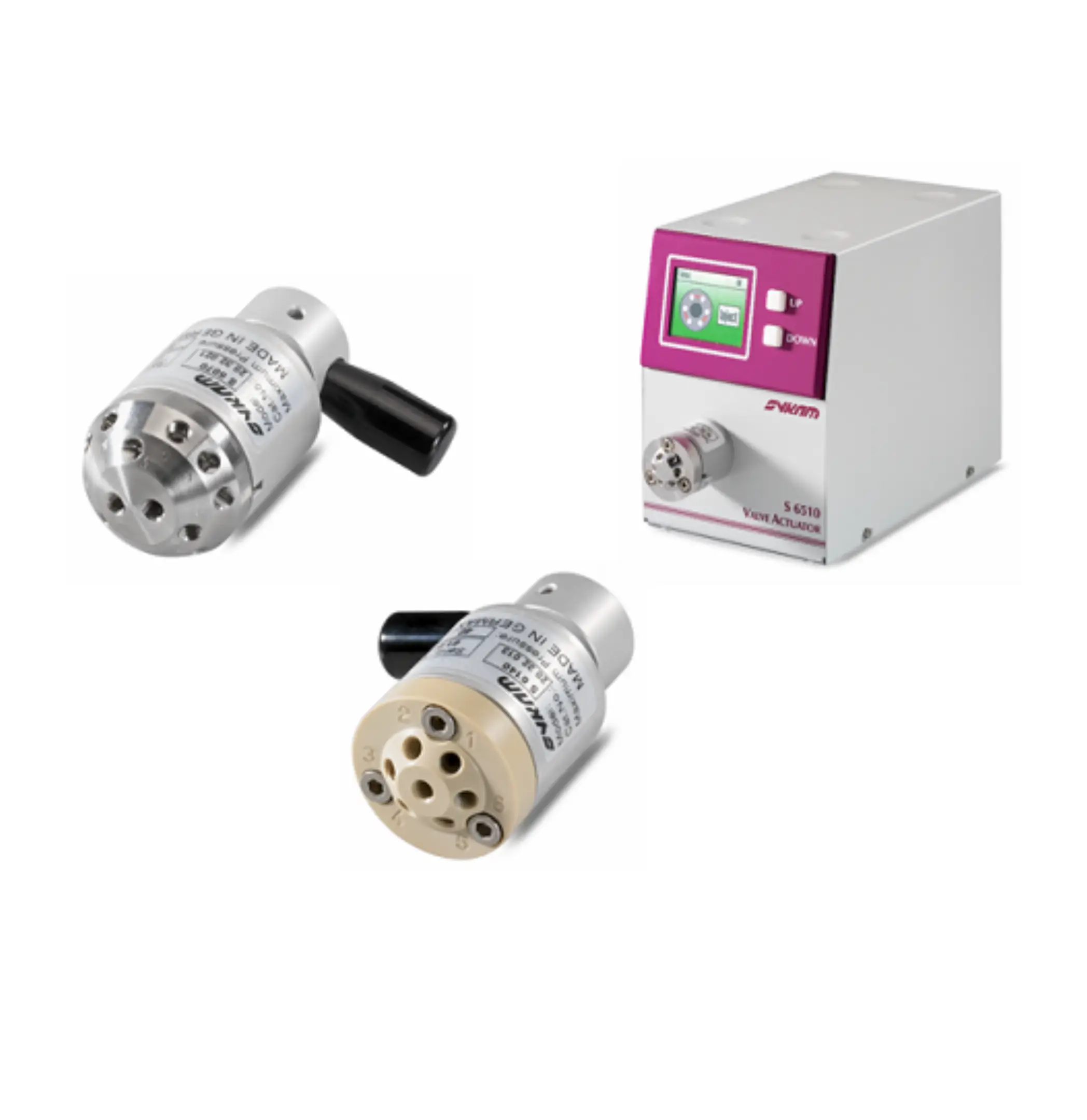
HPLC valves & switching
Durable surfaces, automated switching, and method flexibility without rebuilding the column stack
Sykam supplies a wide portfolio of high-performance valves for analytical and preparative HPLC. Specially developed finishes — including Dia-Dur coatings — maximise wear resistance and service life under real-world solvent and pressure cycling. Electronically actuated valve manifolds let you reconfigure flow paths on demand: you gain variable analytical options from a single system without column rework, so long-run campaigns across different buffer systems or stationary phases stay practical and reproducible.
Why teams specify them
Fewer manual replumbs between sequences, cleaner method hand-offs for regulated labs, and hardware that still seals reliably after thousands of actuations — ideal when your queue mixes aqueous buffers, aggressive organics, or multi-column screening workflows.
Need help choosing degassing, solvent handling, or column thermostat options for your stack? Contact us — we will match accessories to your instruments and methods.