

HPLC detectors
Detection That Keeps Pace With Your Separation
From variable-wavelength UV/Vis through refractive index, evaporative light scattering, diode-array spectral confirmation, and dedicated radio-HPLC — Sykam detectors are built for stable baselines, wide linear range, and years of dependable service. Our S 3245 and S 3250 UV/Vis modules combine a rugged optical bench with exceptional linearity, so routine QC and demanding research methods share the same trusted hardware.
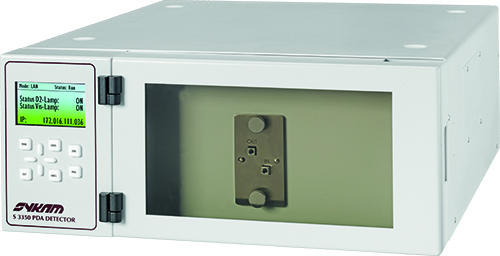
UV/Vis
S 3245 — Variable-Wavelength UV/Vis Detector
Routine and research-grade photometry from 190 nm to 900 nm
The S 3245 is a variable-wavelength UV/Vis detector engineered for methods where baseline stability and linear response matter as much as sensitivity. A dual-lamp optical path (deuterium plus tungsten) delivers full spectral coverage with low baseline noise, while a front-access flow cell speeds maintenance and reduces downtime. Pre-aligned lamps sit in a side-access housing, so lamp exchange stays quick and predictable — ideal for high-throughput labs and teaching environments alike.
Specifications
- Materials
- Stainless steel or PEEK
- Wavelength range
- 190–900 nm
- Light sources
- Deuterium lamp; tungsten lamp
Applications
Pharmaceutical and chemical QC, environmental monitoring, academic teaching labs, and any UV-active method where you need dependable quantitation without constant optical tinkering.
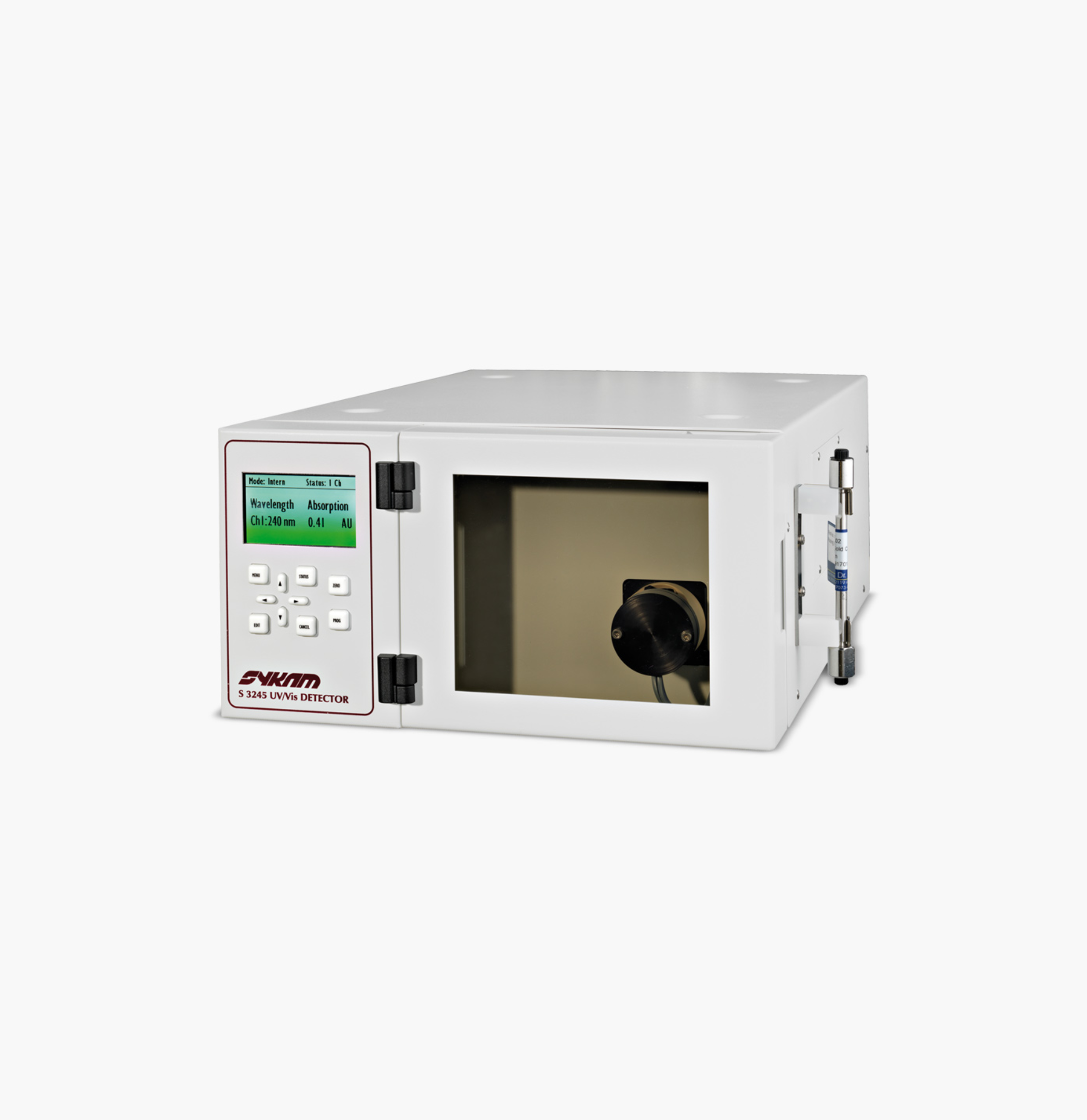
UV/Vis
S 3250 — Variable-Wavelength UV/Vis Detector
The same optical performance as the S 3245 in an expanded enclosure
The S 3250 offers the same dual-lamp UV/Vis engine as the S 3245 — 190–900 nm coverage, low baseline noise, and a user-friendly flow cell — packaged for installations that benefit from a larger chassis. Choose it when rack layout, cable routing, or future option slots favor a full-width module without compromising on wavelength programming or day-to-day service access.
Specifications
- Materials
- Stainless steel or PEEK
- Wavelength range
- 190–900 nm
- Light sources
- Deuterium lamp; tungsten lamp
Applications
Any workflow suited to the S 3245 — with a form factor that fits larger system footprints and integration projects where physical space behind the panel is not the limiting factor.
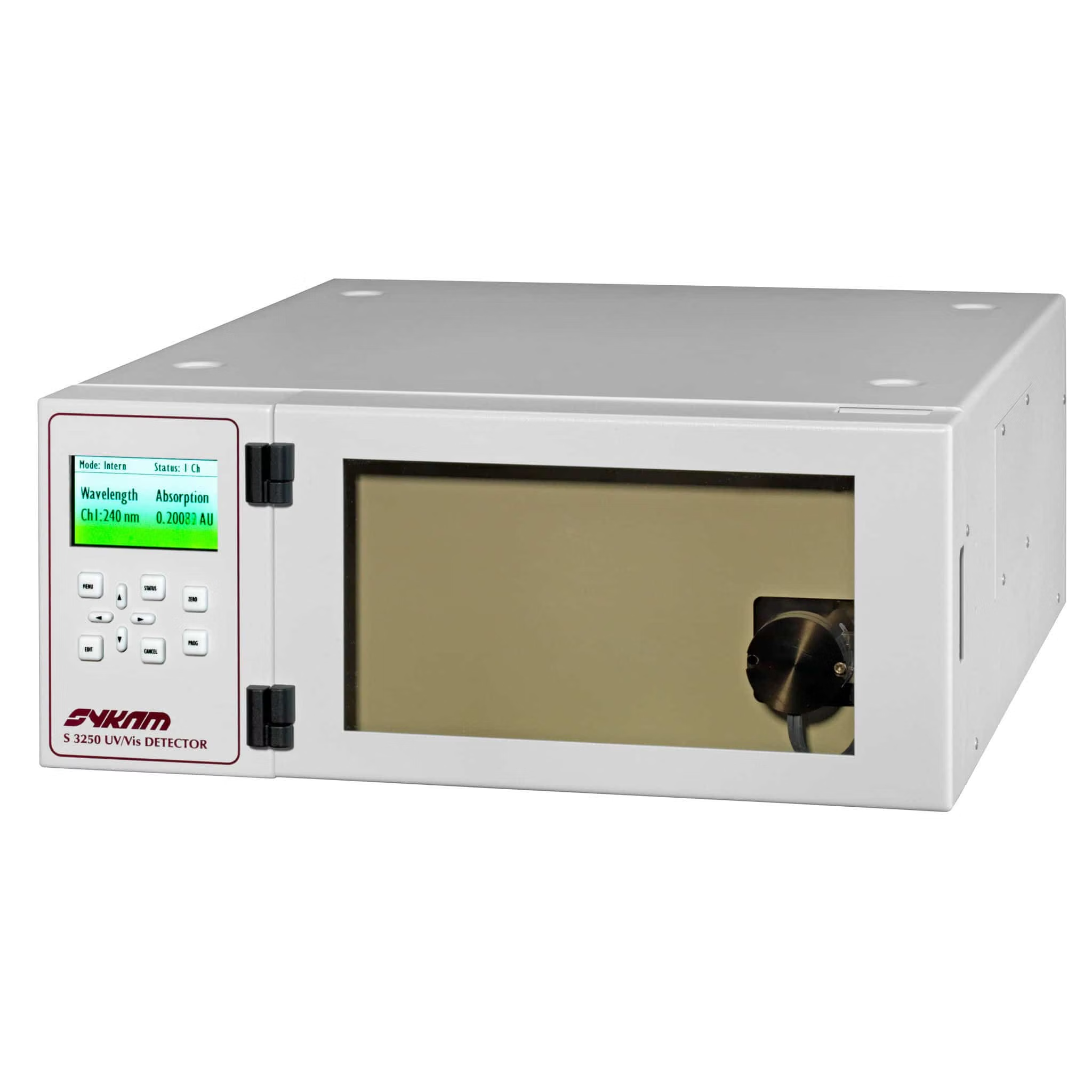
Refractive index
S 3585 — Refractive Index Detector
High sensitivity with the baseline stability RI methods demand
The S 3585 is designed for analysts who work without a chromophore: polymers, sugars, lipids, and many excipients show little or no UV response, yet still need confident quantitation under isocratic conditions. Very high sensitivity pairs with excellent baseline stability, detection sensitivity, and reproducibility — the combination you need when refractive index is your only practical universal channel.
Specifications
- Flow rate — Micro
- 0.2–3 mL/min
- Flow rate — Analytical
- 0.2–3 mL/min
- Flow rate — Semi-preparative
- 1–50 mL/min
- Linearity range — Micro
- 0–500 RIU
- Linearity range — Analytical
- 0–1000 RIU
- Linearity range — Semi-preparative
- 0–20000 RIU
Applications
Carbohydrate and polymer characterization, formulation excipients, surfactants, and other non-UV analytes separated under isocratic elution — wherever a stable RI trace is the difference between a trusted result and ambiguous integration.
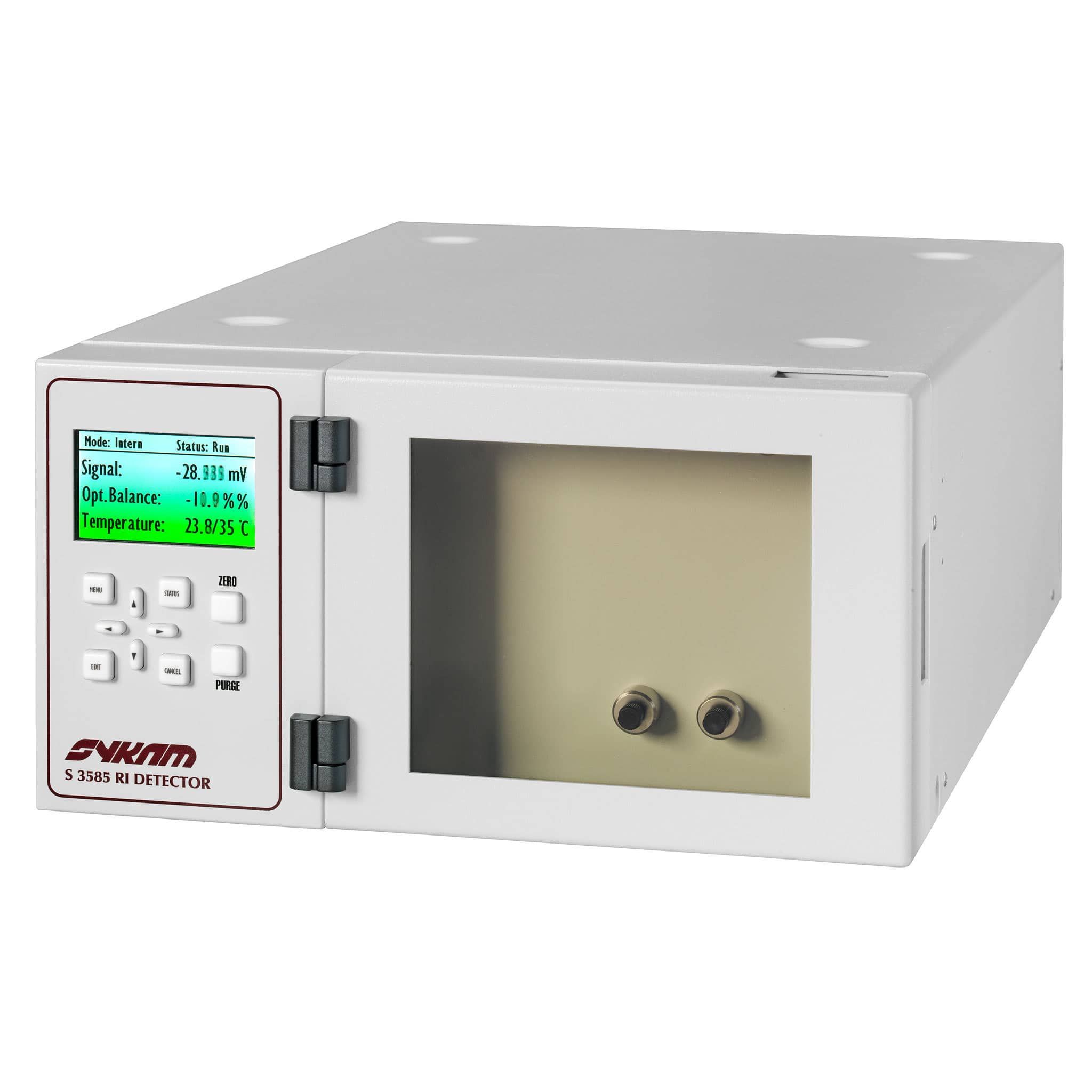
Refractive index
S 3590 — Refractive Index Detector
High sensitivity with the baseline stability RI methods demand
The S 3590 is designed for analysts who work without a chromophore: polymers, sugars, lipids, and many excipients show little or no UV response, yet still need confident quantitation under isocratic conditions. Very high sensitivity pairs with excellent baseline stability, detection sensitivity, and reproducibility — the combination you need when refractive index is your only practical universal channel.
Specifications
- Flow rate — Micro
- 0.2–3 mL/min
- Flow rate — Analytical
- 0.2–3 mL/min
- Flow rate — Semi-preparative
- 1–50 mL/min
- Linearity range — Micro
- 0–500 RIU
- Linearity range — Analytical
- 0–1000 RIU
- Linearity range — Semi-preparative
- 0–20000 RIU
Applications
Carbohydrate and polymer characterization, formulation excipients, surfactants, and other non-UV analytes separated under isocratic elution — wherever a stable RI trace is the difference between a trusted result and ambiguous integration.
PDA / DAD
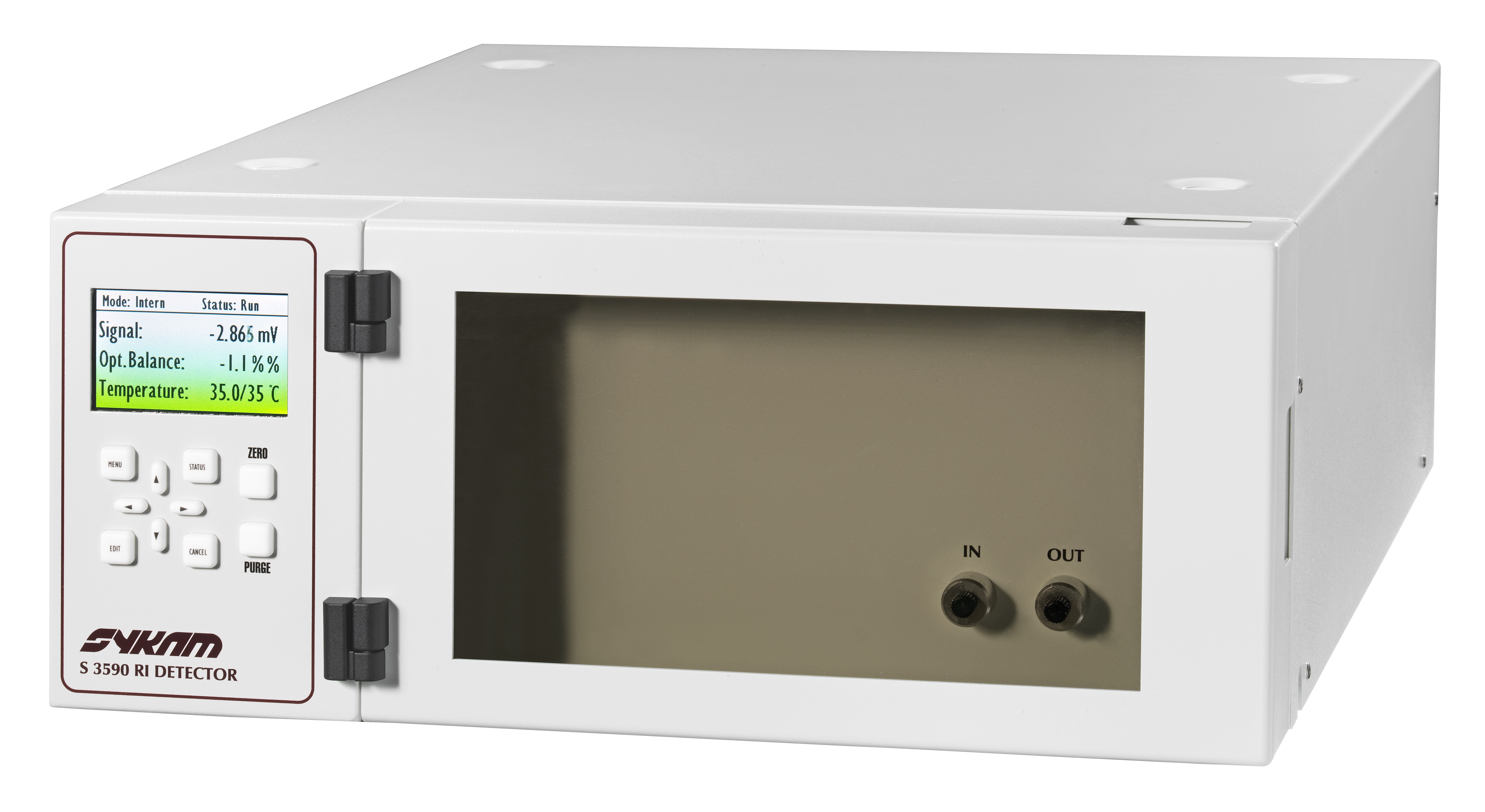
S 3345 — Photodiode-Array (DAD) Detector
Spectral confirmation and multi-wavelength quantitation in one module
The S 3345 diode-array detector captures full spectral context alongside your primary wavelengths: 256 diodes cover 190–720 nm, or choose a 1024-diode configuration for 190–1015 nm coverage when deep-UV or extended-range characterization matters. Dual-lamp excitation (deuterium and tungsten), fiber optics, and a Z-shaped flow cell work together for high sensitivity with low noise. Four independent wavelength channels run in parallel for ratioing and multi-compound workflows, and an integrated peak detector adds standalone usability when you need a fast, self-contained signal.
Specifications
- Fluid-contact materials
- Stainless steel / PEEK, PTFE, glass
- Wavelength range
- 190–720 nm (256 diodes); optional 190–1015 nm (1024 diodes)
- Light sources
- Deuterium lamp; tungsten lamp
- Baseline noise
- ± 1 × 10⁻⁵ AU at 240 nm
- Baseline drift
- < 3 × 10⁻⁴ AU/h
- Wavelength accuracy
- 0.5 nm
- Mean pixel pitch
- 2.2 nm
- Linearity
- > 2.0 AU
- Power supply
- 100–250 V~ (47–63 Hz)
- Flow cell
- Stainless steel or PEEK; analytical / preparative
Applications
Peak purity checks, impurity profiling, method development, and regulated environments where spectral libraries and multi-wavelength traces support documentation and faster troubleshooting.
PDA / DAD
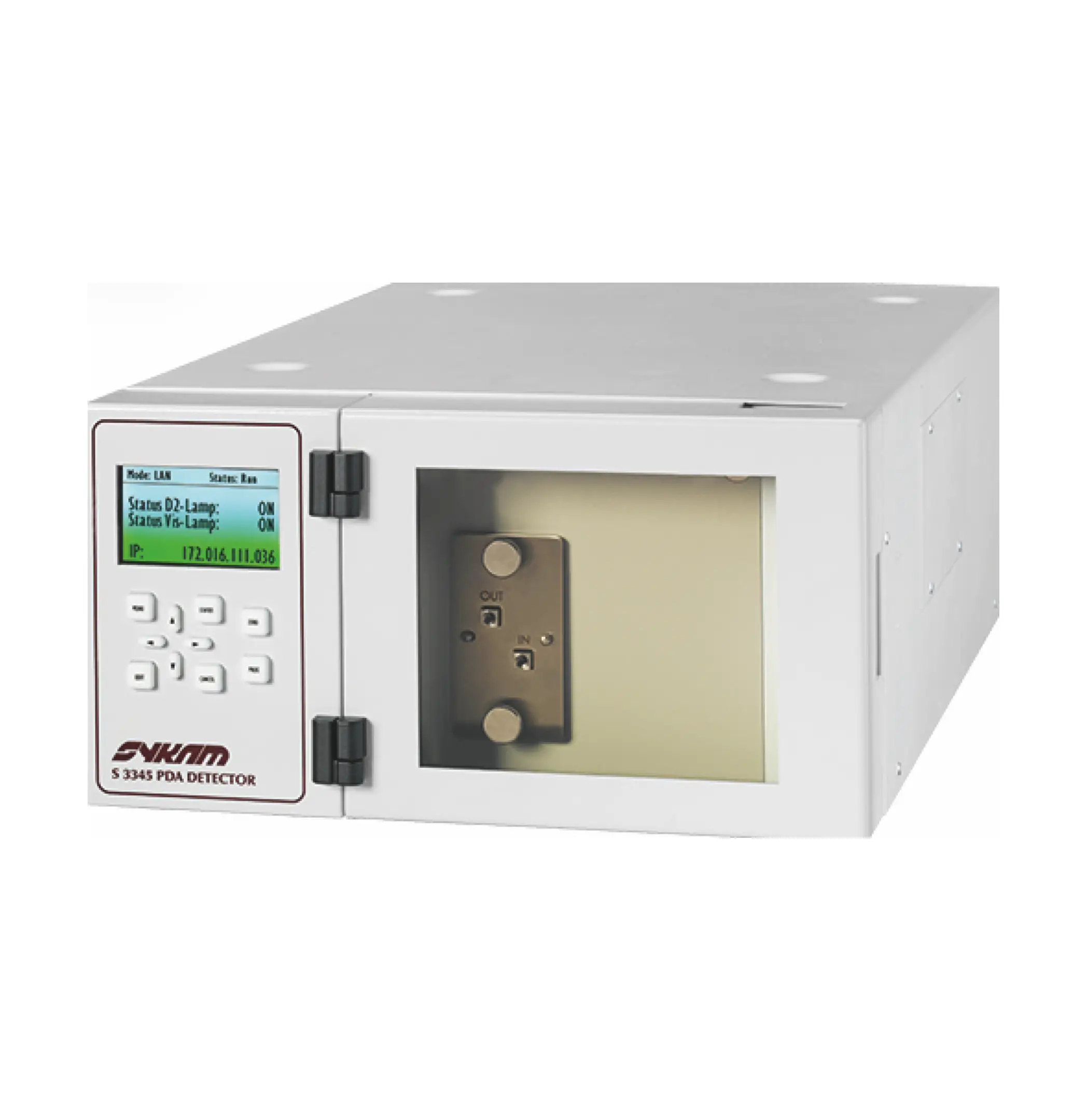
S 3350 — Photodiode-Array (DAD) Detector
Same DAD intelligence with a larger system footprint
The S 3350 delivers the same diode-array performance as the S 3345 — dual-lamp optics, fiber-coupled Z-cell, four simultaneous wavelength channels, integrated peak detection, and optional extended spectral range with 1024 diodes — in an enclosure suited to installations that prioritize rack layout and expansion. If your qualification plan or cabinet design calls for more physical room without stepping down in optical capability, the S 3350 is the parallel choice.
Specifications
- Fluid-contact materials
- Stainless steel / PEEK, PTFE, glass
- Wavelength range
- 190–720 nm (256 diodes); optional 190–1015 nm (1024 diodes)
- Light sources
- Deuterium lamp; tungsten lamp
- Baseline noise
- ± 1 × 10⁻⁵ AU at 240 nm
- Baseline drift
- < 3 × 10⁻⁴ AU/h
- Wavelength accuracy
- 0.5 nm
- Mean pixel pitch
- 2.2 nm
- Linearity
- > 2.0 AU
- Power supply
- 100–250 V~ (47–63 Hz)
- Flow cell
- Stainless steel or PEEK; analytical / preparative
Applications
Identical application scope to the S 3345 — spectral method development, QA/QC, and research — with a hardware format tailored to larger stacks and OEM integration.
Radio-HPLC
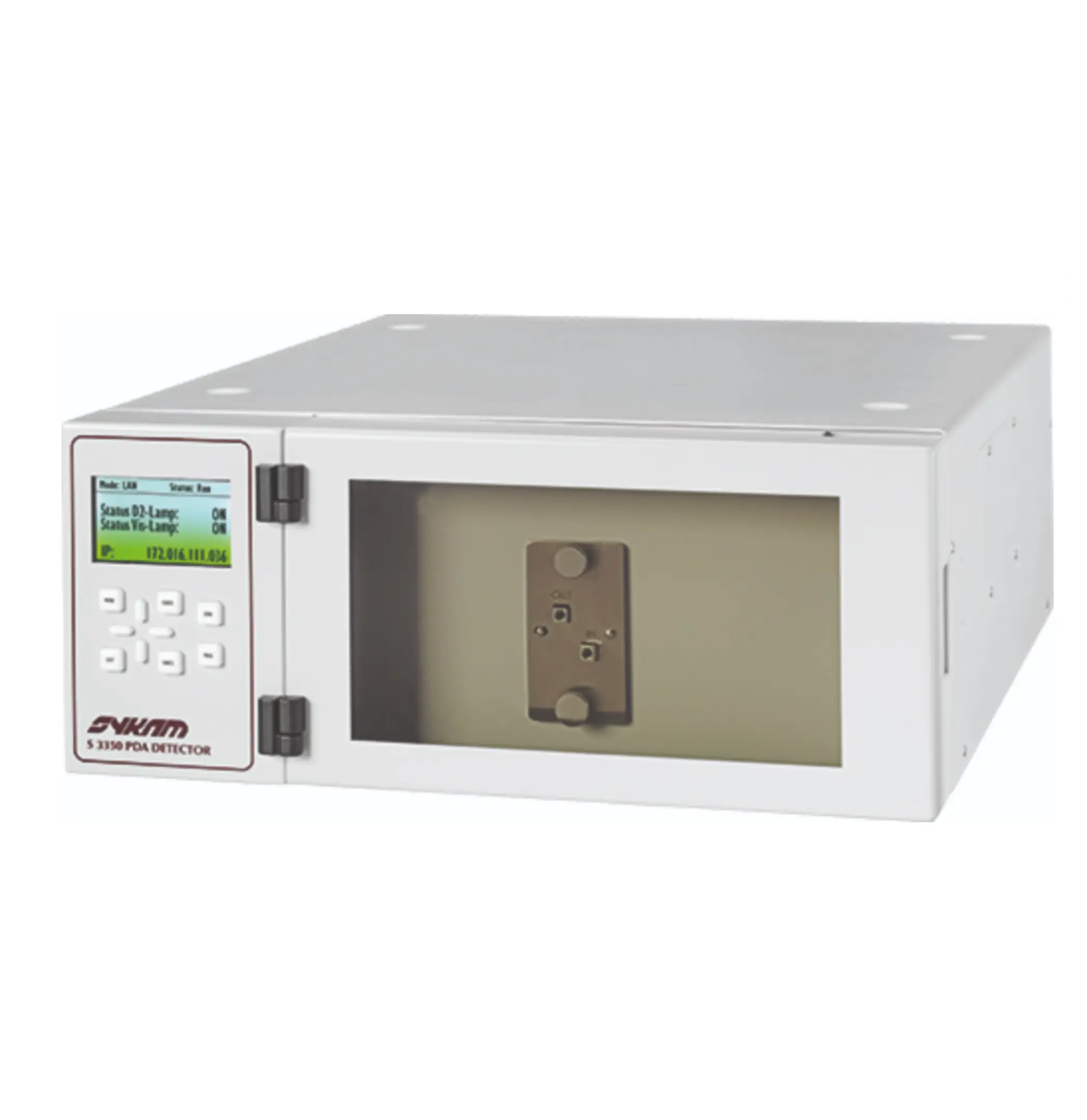
S 3700 — Radioactivity Detector
Sensitive γ and positron detection with flexible loop volumes
The S 3700 couples a sensitive 2″ NaI(Tl) scintillation detector with a bore-hole crystal in 4π geometry for both gamma (20–1300 keV) and positron detection. Interchangeable measurement loops give you flexibility across activity levels and peak widths, while automatic half-life correction keeps reported peak intensities physically meaningful. Wetted components are fully shielded, and an integrated injection valve streamlines radiochemical workflows where time-to-result and operator safety are non-negotiable.
Specifications
- Materials
- Metal-free (e.g., PEEK)
- Detector
- NaI(Tl) scintillation detector with photomultiplier
- Maximum sensitivity
- 511 keV
Applications
Radiopharmaceutical development and QC, nuclear medicine, and tracer studies where fast, reliable nuclide-specific response and flexible loop sizing support both R&D and release testing.
Choosing between UV/Vis, RI, ELSD, PDA, and radio detection depends on your chemistry, elution mode, and regulatory context. Contact us — we will help you match detector technology to your methods and integration requirements.